


In Tattooing, is Saran Wrap a Good Choice for Barrier Film or Bandaging? Are There Good Alternatives?
Updated: Mar 19
Saran is the trade name of a thin plastic wrap that has been used to maintain food freshness and protect sensitive products from moisture, oxygen, rot, or corrosion since the 1940's. The main compound, polyvinylidene chloride (PVDC), was discovered by accident in 1933 by an employee at the Dow Chemical company, and was officially trademarked as "Saran" in 1940. Since then, it has gone through some significant changes that have brought its effectiveness into question. It has now been a household standard for coming up on a century, and used in some tattoo shops for decades.
Outside of the common kitchen, you may have seen it in use at tattoo conventions, or even at a tattoo appointment of your own. Saran wrap or similar generic cling-films are used to cover surfaces that may be exposed to bodily fluids, or even as bandaging for a fresh tattoo.
Let's briefly explore why these may not be the best ideas for the tattoo industry, as well as a strong and effective alternative for surface protection and bandaging.
Saran as a Surface Barrier Vs. a Cotton, Polymer, Polypropylene (Bed/Incontinence) Pad
Saran Wrap was made originally using PVDC, which provides a significant oxygen and moisture barrier, vastly extending the longevity of food. After the trademark was obtained by S.C. Johnson & Son, Inc. in 1998, due to its chlorine content, the primary component in Saran was changed to polyethylene. This turned out to be a far less effective barrier, as it allows a higher permeability of gases and moisture, not only reducing its effectiveness in preserving food storage, but also in maintaining sterility or protecting sensitive medical materials.
In tattooing, we deal with blood on a daily basis. Any tiny amount of which may contain bloodborne pathogens, such as hepatitis, which can live on a surface for many weeks.
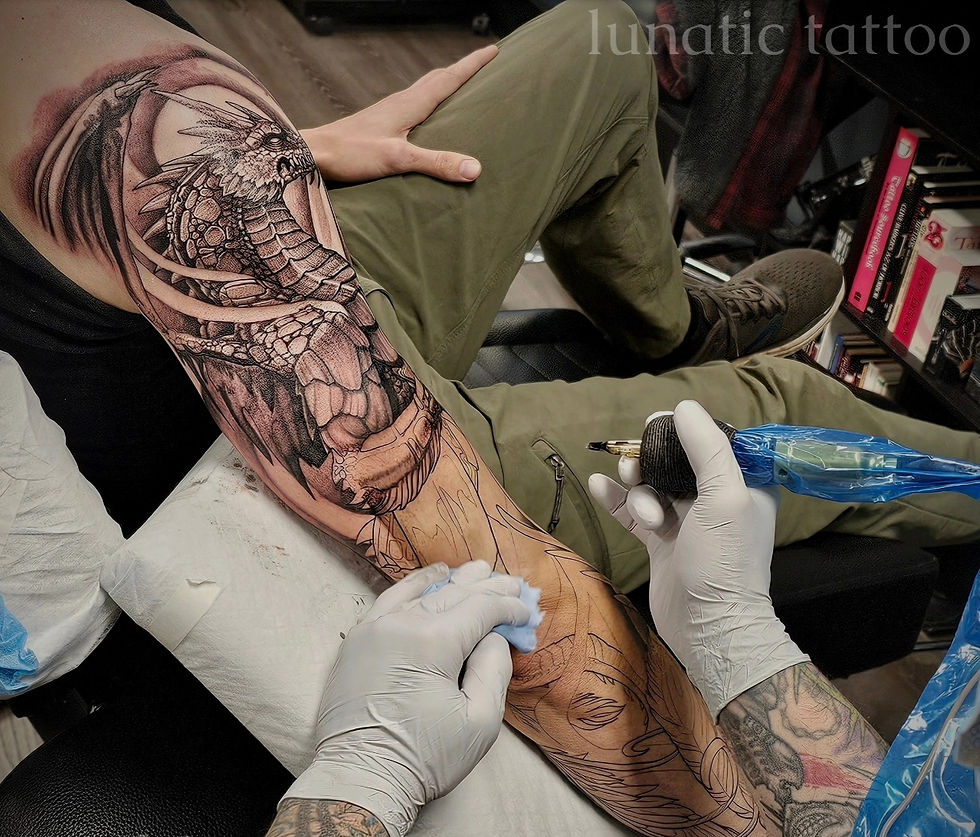
Some less reputable tattoo artists claim that they don't need to cover any surface that they work from, like a massage table or arm rest, since they spray a disinfectant on the surface afterwards. This is completely horrific for anyone with any sense of cross contamination at all. Most surfaces, including steel and plastic, are eventually porous with microdamage over time. This means that they will contain small, imperceivable pits and cavities that act like sports stadiums for viruses and other microbiotic adversaries that mean to do us harm.
When tattooing, artists have to pull the skin tight in order for the needles to penetrate effectively, essentially creating a micro-trampoline or drum face that we're bouncing up and down at a rate of 300-500 times a minute. This results in a microscopic cloud of material that surrounds the immediate area in a thin coat of liquid that is contaminated with bodily fluids.
Saran does not absorb liquids that land on it, and after hours of tattooing, any arm rest, chair, or massage table used in the process may have a large amount of bodily fluids and tattoo ink that's mixed with blood and plasma. It can take significant time for this tattoo soup to dry, meaning that it's got some time to relocate and move around before it gets settled. Any liquid left on a surface, even if it's incredibly small, can leave a trace if it's not thoroughly eradicated through cleaning and disinfection.
The best way to prevent this from being an issue at all, is to prevent any contamination of the surface to begin with. Best practices demand a surface barrier or cover. Medical barrier films exist, and there are tattoo-specific products in abundance these days that will safely and effectively do the trick.
Although a kitchen intended plastic wrap may stop a lot of liquid contaminant from bonding with a surface, much of it remains liquid, which is very difficult to safely and cleanly remove when breaking down a tattoo station. Small amounts of liquid transfer are all it takes for a surface to be contaminated. We've all seen the crime shows, and there's freaking DNA everywhere! Tattoo studios that don't pursue aseptic technique (clean practices) are often one big murder scene trying to make its way into your body, so be careful out there!

A Cotton, Polymer, Polypropylene Pad (bed/incontinence pad), is an excellent choice to cover a lot of surfaces involved in tattooing. These products were designed specifically to absorb large amounts of liquid, but not allow any to pass through. Two 36"x36" tear resistant pads will cover 95% of a massage table, and will not only absorb any liquids that land on it, but it's poly-layer design has an impermeable final layer that will not allow liquids to penetrate through it, making it an ideal candidate for covering large areas that will be tattooed on or near.
Pay attention to any station or setup that you are going to be tattooed from. If there are loose layers of plastic wrap on top of older layers of plastic wrap, swiftly consider making your exit.
Transparent Film Dressing (TFDs) versus Kitchen Accessories
Saran wrap is a poor bandage for fresh tattoos because it does not adhere or seal well, and not being able to absorb, this style of bandage can leak dramatically, creating a big, bloody mess. This lack of seal can lead to an infection, delayed healing, and scarring. Unlike medical-grade TFD alternatives, saran wrap does not allow oxygen exchange or water vapor to escape, essentially suffocating the wound.
In contrast, TFDs, such as Saniderm or ViewGuard, are specifically designed for tattoo aftercare. TFDs were originally created in the 1970's after the concept of moist wound healing was introduced. This scientific breakthrough demonstrated that wounds heal faster and with less scarring when kept in a moist environment, shifting away from the traditional practice of leaving wounds open to dry. The balanced environment beneath the film promotes autolysis, a natural healing process where dead cells are broken down and reabsorbed, accelerating tissue repair.
TFDs quickly found their way into the modern tattoo industry during the early 2000's. They are breathable yet waterproof, allowing oxygen and moisture vapor to pass through while blocking bacteria and dirt. This one-way vapor transmission is crucial in wound care and sanitary bandaging, where protection from external contaminants is required, but internal moisture buildup must be avoided.
These medical-grade bandages trap the skin’s natural healing fluids, such as lymph and plasma, to keep the tattoo actively repairing, reduce scabbing, and promote faster, cleaner healing—without the risks associated with plastic wrap. Left on normally for 3-5 days, some brands can stay on for up to 7 days.

Using saran wrap is also discouraged by professional tattoo associations and some states (like Hawaii), which classify it as unsanitary for open wounds. While some artists still use it temporarily as a quick cover while applying some tattoo numbing products during the tattoo session, and there is nothing wrong with this practice, it should never be left on for extended periods. Luckily, there are practical and purpose-built alternatives for tattoo aftercare.
Drawbacks from Transparent Film Dressings
Of course, some things come at a cost, and not every skin type or location on the body are suitable for TFDs. Additionally, it's important to note that there are a few people out there who are sensitive to medical adhesives, or polyurethane, one of the main ingredients in TFDs.
Symptoms can include: redness, itching, rash, hives, blistering, or general contact dermatitis
The reports of reactions are luckily fairly rare, but may be becoming more common as the data builds. Although care has been taken to create a hypoallergenic product, unfortunately reactions to TFDs do occasionally occur, and can be very uncomfortable. Luckily, they don't seem to affect the end result of the tattoo. If you ever encounter these symptoms, you should gently moisten the edges of, then remove your TFD and consult your physician if you feel you are experiencing a severe allergic reaction.
Some areas of the body are very dynamic, and move around a lot. TFDs should be applied in such a way that they will move with you, and not against your natural positions or motions. Some redness and itchiness will occur at areas that have strain on them. These are known as mechanical irritation. While not an allergic reaction, tension blisters or skin stripping from improper application or removal can mimic allergic reactions
Cotton Polypads as a Bandaging Alternative
Prior to TFDs, most tattoo artists would send you out the door with little more than a pat on the back and a new tattoo. Temporary bandages like plastic wrap and meat pads, as well as cotton polypads have been used in the tattoo world for decades now. For our tattoo suggestions and guidlines, check out this link here.
When used in combination with coban wrap, a cotton polypad has been proven to be an excellent bandaging solution for entire arm & leg sleeves, and even entire torsos. The product does not adhere to the wound, and will absorb any excessive bleeding or moisture, but still allows breathing. A light ointment application and even dressing, and it will start the healing process safely and effectively until morning, or up to, but not over 24 hours.
Cost Vs Safety
Cotton polypads are ideal for the type of work that tattoo artists do, and after years of research and practical application in the industry, it seems that there is yet to be a better and more cost-effective solution for protecting surfaces from bloodborne pathogens and as a solid bandaging alternative. Some tattoo artists exclaim that it's too expensive to justify this sort of additional cost, and many others would disagree strongly for several reasons. Primarily, if you, as a tattoo artist, are charging anyone $100 + for a tattoo, then $1.50 added cost for safety and professionalism is easily worth it, in our humble opinion.

Summary
Modern saran wrap does not allow oxygen and water permeation, nor does it absorb excess fluid buildup, which essentially renders it useless as a sanitary barrier or practical tattoo bandage. There are industry-specific and very effective products on the market today that are readily available at a very reasonable cost.
The best infection control strategy combines both disinfection, and barrier protection. Make sure that your tattoo artist has taken the time and invested in your safety. Come see why Lunatic Tattoo is the Vancouver and Portland area's high-end choice!


Comments